Everyone in the outdoor basketball court installation field has learned one thing in particular: an outdoor basketball court that fails begins at the bottom, not the top. Before installing a single tile of bio-based flooring, you must check, verify, and document the substrate below. Without this step, premature cracking, uneven play surfaces, water pooling, and expensive repairs can easily exceed the initial cost.
Here are the 3 non-negotiable checkpoints for building an outdoor court before installation. From a school to a recreation center to a residential property, these steps will safeguard your project, your flooring investment, and all who play on that court.
Why Base Inspection Drives Outdoor Basketball Court Construction Success
Most court failures actually start at the sub-base. Without proper compaction of the sub-base, or curing or finishing the concrete or asphalt pad correctly to specification, nothing will support a surface system on top of it.
This is an important piece of advice from the experts when it comes to building a court, and it’s certainly relevant to bio-based flooring such as CopoSports’s. CopoSports is the top supplier of bio-based outdoor basketball court flooring in the United States, and Macwood and modular basketball court systems are engineered to perform at the highest level when the foundation under the floor meets technical standards.
When it comes to building an outdoor basketball court, it is a matter of precision in the substrate. You can repeat the three checkpoints listed below to ensure your surface investment is safe from day one.
Checkpoint 1: Document the Condition of the Substrate
The contractor or site supervisor shall make a complete visual and physical examination of the existing substrate prior to the start of the outdoor basketball court installation. This step is a must. It establishes a legal and technical record to defend all parties.
What to Inspect
Examine the entire surface area for the following defects:
- Cracks and fractures: Hairline cracks under 2mm wide typically accept bio-based modular systems without remediation. Structural cracks wider than 5mm require filling and curing before installation proceeds.
- Delamination and spalling: Flaking or lifting concrete compromises the mechanical bond between the substrate and the flooring system.
- Surface contamination: Oil, paint, standing water, algae, or chemical residue must come off the surface completely before any flooring goes down.
- Previous coatings: Old acrylic or epoxy layers that show delamination require mechanical removal, not just re-coating.
- Drainage channels and expansion joints: Mark the location of all existing joints. The installer maps flooring tile layouts around these points to prevent stress concentration.
How to Document
Site inspection form with photographic evidence. Capture photos from different angles at the time of the incident. Write the following for each defect found:
- Location on the court (use a simple grid reference)
- Type of defect
- Approximate dimensions
- Recommended remediation action
- Responsibility assignment (site owner vs. contractor)
Your outdoor basketball court’s longevity of crack-free, level play is most dependent on its stable base and well-drained foundation. Proper site preparation will eliminate water pooling and help the court last as long as expected.
The second vital role of documentation is to set the condition of the substrate at handover. When a defect is discovered 6 months after the construction of the outdoor court, the inspection record helps to determine if the defect was present prior to or following installation. This is to safeguard the installer and the client.
CopoSports Substrate Standard
CopoSports bio-based outdoor basketball court flooring systems need a substrate that has:
- Surface flatness tolerance of ±3mm measured over any 3-meter straightedge
- No structural cracks wider than 5mm without prior grouting
- Clean, dry, and free of loose material at the time of installation
- Concrete strength minimum of 3000 PSI or equivalent asphalt compaction specification
Document any variance from these standards in writing before outdoor basketball court installation begins.
Checkpoint 2: Verify Slope and Evenness in Accordance with System Requirements
A challenge that outdoor court construction presents that indoor courts do not have to deal with is water management. Precipitation, overspray from irrigation, and condensation all puddle on horizontal surfaces and can create significant long-term damage. The answer: a highly sophisticated drainage slope, but this has to be within a certain tolerance.
The Required Slope Range
Standard outdoor basketball courts should have a 1% slope (which is approximately 1/8 inch per foot) to drain water without a noticeable slope.
This is the CopoSports standard and is consistent with the FIBA technical guidelines. The recommended slope for outdoor basketball court installation is 1:100 (1%) in a continuous direction. Courts sloped up to 2% are a compromise for player experience and may be against the rules of competition.
Both bases have a 1:100 slope to ensure water runs away from the basketball court, preventing damage to the floor.
Slopes of less than 0.5% are too flat to drain well. When the grades are greater than 2%, it becomes a sloped field, literally. Both are unsuitable as an acceptable substrate for CopoSports bio-based flooring systems.
How to Measure Slope
Measure the slope of the substrate in several directions using a digital level or laser transit. Read at least 5 points within 50 m² of the court. Put in your inspection report any readings that occurred.
When building outdoor courts that are large, use a transit level and staff rod to set true grade throughout the court area. Use chalk/paint to mark high/low points on the slab. Outside the band of acceptable values (between 1:100 and 2:100), a correction is required.
How to Measure Evenness
Surface evenness is different from slope. The overall slope or grade of the slab is called slope. Evenness refers to the local flatness (absence of bumps, dips, and waves over short distances).
Use a 3-meter straightedge to sweep the surface systematically. The maximum allowable gap between the straightedge and the substrate is ±3mm. Mark every location where the gap exceeds tolerance. These areas require grinding (for high spots) or self-leveling compound (for low spots) before outdoor basketball court installation proceeds.
Common Slope and Evenness Problems
|
Issue |
Cause |
Remediation |
|---|---|---|
|
Reverse slope (water pools at center) |
Incorrect original grade |
Full slab correction or strategic infill |
|
Cross-slope exceeds 2% |
Poor original construction |
Grinding or capping with new concrete layer |
|
Localized depressions |
Soil settlement or pour error |
Self-leveling compound, minimum 48-hour cure |
|
High spots over expansion joints |
Joint filler shrinkage |
Grinding flush before installation |
Check second inspection for all corrections to be within tolerance before going to the outside court to do the flooring. Performance guarantee based on base conformance: Never install CopoSports bio-based flooring on a substrate that does not meet the slope and evenness requirements.
Checkpoint 3: Confirm Handover and Rectification Records
Third checkpoint brings site work to a formal, binding process. Handover documentation fills in the space between site preparation and installing the flooring. It ensures that each issue raised during Checkpoint 1 and corrected during Checkpoint 2 is correct and complete prior to basketball court installation outdoors.
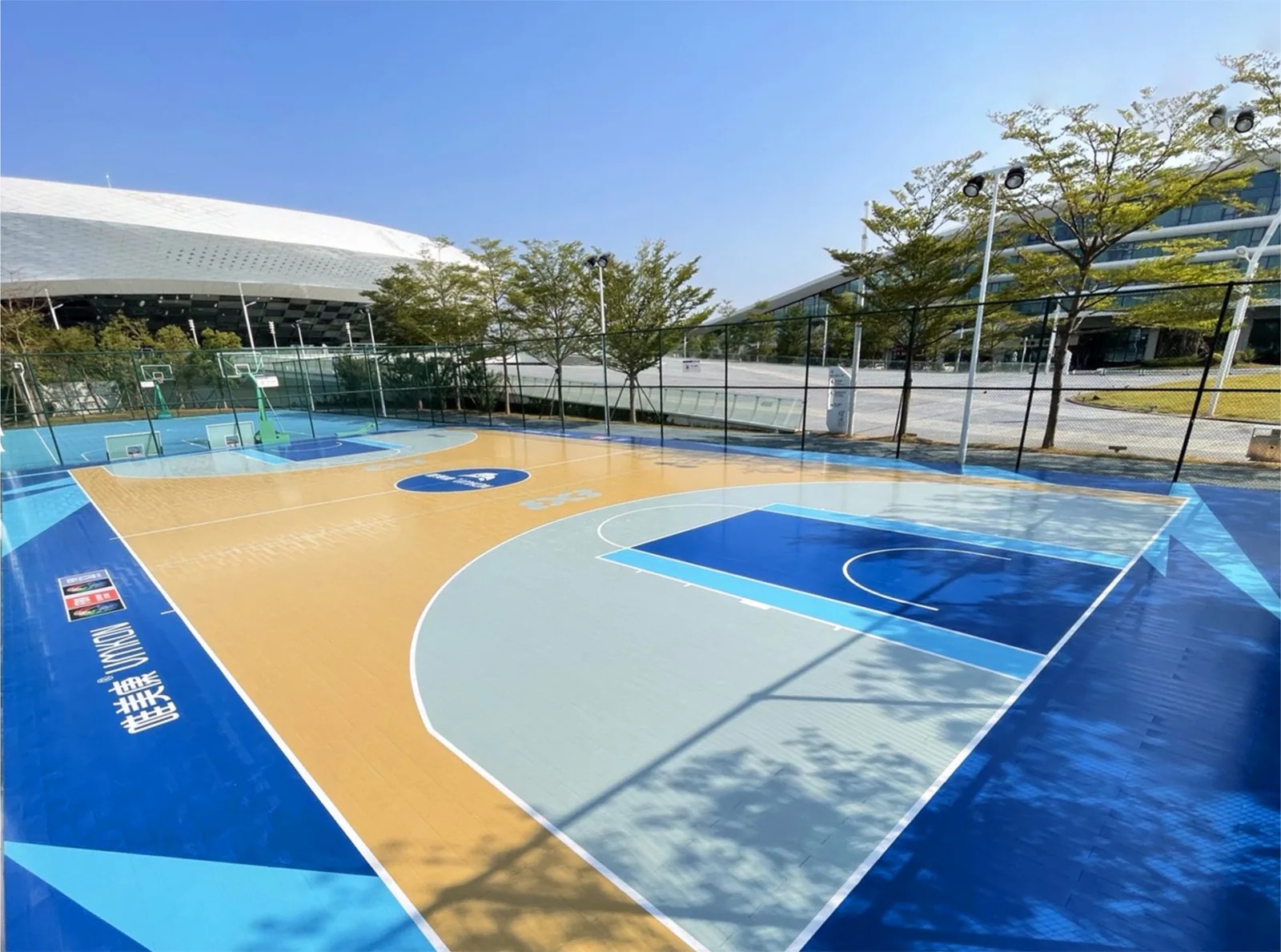
What the Handover Record Must Include
A complete handover package for outdoor court construction includes:
- Pre-installation substrate inspection report: includes all defects identified, with photos and dimensions.
- Rectification log: itemizes every corrective action taken, the method used, materials applied, and the date completed.
- Post-rectification inspection results: confirms that slope, evenness, cleanliness, and structural integrity all meet CopoSports system requirements.
- Cure time confirmation: for any self-leveling compound, concrete patch, or new slab pour, documents the minimum cure period (typically 28 days for new concrete, 48 hours for patching compounds).
- Sign-off signatures: site owner or owner’s representative, general contractor, and CopoSports-authorized installer all sign the document.
Why Handover Records Protect Your Investment
A thorough inspection is conducted before the court is opened for use to ensure that everything is safe and functioning as required. Contractors check courts to ensure they are the correct size, level, and have the correct drainage slope.
The handover record not only checks the finished surface, but it also checks the base. Sets responsibility in a step-by-step process of outdoor basketball court construction.
The handover record is a way for a property owner to prove that due diligence took place. It provides installers with protection from liability for the failure of the underlying substrate. For CopoSports it guarantees that the bio-based flooring system is following how it is designed and warranted.
Rectification Sign-Off Checklist
To verify that these items have been completed, please check the handover form before the CopoSports installer installs the first piece of outdoor basketball court flooring:
- All structural cracks filled, cured, and re-inspected
- Surface contamination removed and surface cleaned
- Slope verified within 1:100 to 2:100 across the full court area
- Evenness verified at ±3mm maximum deviation per 3-meter span
- All high spots ground flush
- All low spots filled and cured
- Expansion joints mapped and recorded
- Moisture content tested and within acceptable range
- Site owner has countersigned the inspection record
- CopoSports installer has confirmed substrate acceptance
Do not proceed with outdoor basketball court installation until every item on this list carries a confirmed check mark.
Choose CopoSports for Your Outdoor Basketball Court Construction
Based in Temple City, California, CopoSports is a trusted designer and manufacturer of bio-based sports flooring systems certified for outdoor basketball courts by FIBA. Designed to provide real hardwood performance outdoors, CopoSports’ Macwood Bio-Based sports flooring is the first bio-based, waterproof sports flooring in the world, available in pro, standard, elite, and portable.
An American brand, CopoSports develops bio-based outdoor basketball court flooring to withstand extreme weather conditions, including UV, thermal cycling, rain, and heavy use. This flooring system is REACH and RoHS compliant, ISO 9001:2015 certified, and designed for the outdoor environment American communities play in.
The base inspection procedure outlined in this guide is directly aligned to CopoSports’ base installation standards. Documentation of the substrate, checking slope and flatness, and checking handover lists are the way to ensure a CopoSports bio-based surface will provide years of championship performance.
Ready to start your outdoor basketball court installation project?
Explore CopoSports Outdoor Basketball Court Flooring →
Frequently Asked Questions About Outdoor Court Base Inspection
What is the minimum concrete strength for outdoor basketball court installation?
CopoSports requires a minimum concrete substrate strength of 3000 PSI. Asphalt substrates must meet equivalent compaction specifications, typically 95% compaction per standard Proctor test.
How long must a new concrete slab cure before outdoor court construction proceeds?
New concrete requires a minimum 28-day cure period before any flooring installation. Patching compounds and self-leveling underlayments require a minimum 48-hour cure and must pass a moisture test before the flooring installs.
What is the acceptable slope for an outdoor basketball court base?
The acceptable drainage slope is 1:100 (1%). Slopes below 0.5% cause pooling. Slopes above 2% affect play quality and may fall outside competitive specifications.
Can you install CopoSports bio-based flooring over cracked concrete?
You can install over hairline cracks under 2mm with no remediation. Cracks 2–5mm require epoxy crack filler and a curing period. Structural cracks wider than 5mm require full repair before outdoor basketball court installation proceeds.
What documentation does CopoSports require before installation?
CopoSports-authorized installers require a completed substrate inspection report, a rectification log, post-correction measurement results, cure time confirmation, and signed handover documentation from both the site owner and the general contractor.