Keep the base when cracks stay hairline to moderate, and the slab stays level. Rebuild when the base shifts, sections heave, or water pools on the court after rain. Use this guide to inspect your court, classify every defect, outdoor basketball court resurfacing and pick the path that saves you money long term.
Why This Decision Costs More Than You Think
The question that all schools, parks departments, and HOAs with an aging court must now ask themselves is: pay 4k-12k to resurface an outdoor basketball court or pay the 60k-80k+ for a full rebuild?
The incorrect selection increases your expenses by a factor of. Repair over old repair, and you’re purchasing 18 months before the same fissures reappear in the fresh repair. Let’s demolish and rebuild a structurally sound court, and you waste a foundation that could last for another ten years.
The decision starts with one place: the cracks.
Step 1: Investigate Cracks and Settlement
Avoid beginning with quotes from contractors. Begin with a walk-through of the site, walking with measuring tape, notepads, and a straight edge. The results of that walk will dictate whether outdoor basketball court resurfacing is necessary or a full base replacement.
Classify Every Crack You Find
Walk the court systematically and log each crack by width, pattern, and edge condition. Use this classification:
| Crack Type | Width | Edge Condition | Likely Cause |
|---|---|---|---|
| Hairline | < 1/8 in | Flush, stable | Surface shrinkage or thermal cycling |
| Moderate | 1/8–1/4 in | Flush or slight offset | Aging surface layer, minor joint movement |
| Structural | > 1/4 in | One side higher than the other | Sub-base movement, settlement, or frost heave |
| Alligator/Map | Branching web pattern | Often depressed | Base failure, water infiltration, load failure |
The critical test: Test with a straight edge across the crack. The ground has moved if one side is a quarter of an inch higher than the other. A moving base cannot be corrected with filler or coating. This is not a resurfacing job for that court; it is a rebuilding of the court.
Check for Settlement
Settlement appears as low-lying areas that retain rainwater. Be on the court within 60 minutes of rain. Standing water indicates bad drainage and is either a resurfacing fix or a build-again trigger.
Take a walk around the perimeter as well. Edges that are heaving indicate that the sub-base is wet and is still seasonal.
Probe Soft Spots
Apply pressure on the affected areas that may appear sunken or discolored. Moisture that reaches the base layer compromises its load-bearing capacity and is identified by soft or spongy areas under the surface coating. Indicate all soft spots on your site map.
Step 2: Distinguish Resurfaceable Problems from Reconstruction Problems
After the site walk, sort every defect into one of two columns.
Problems You Can Resurface Over
Outdoor basketball court resurfacing handles these conditions reliably:
- Faded or oxidized surface color: UV degradation removes color without impacting structure. It’s restored with a new layer of acrylic coating.
- Surface texture loss: Poor grip on the surface. Re-Texture recreates texture and grip.
- Hairline-to-moderate cracks with flush edges: These are filled with flexible crack filler, which is covered over with the resurfacing system. If the base is not moving, then the repair is not moving.
- Line marking deterioration: Repaint of faded three-point arc, lane markings, and center circle lines within the scope of resurfacing.
- Minor surface drainage issues: A competent resurfacing crew grades the new coating layer to restore the 1% minimum slope required for proper drainage of water.
Resurfacing can be completed in 5-10 days (cure time included), and the cost of resurfacing is $3-$6 per square foot for a typical 94 x 50 foot outdoor court or approximately 4,000-12,000 square feet for a complete court resurfacing.
Problems That Demand Reconstruction
Do not resurface when you find any of these conditions:
- Offset cracks: Cracks with one side higher than the other indicate base movement. Resurfacing over it will put the rebuild back one or two seasons and is an investment in resurfacing as well as rebuilding.
- Alligator cracking across large areas: Map cracking is cracking that covers more than 25% of the court surface, which indicates failure of the base layer and not surface wear.
- Persistent standing water: Drainage failure below the surface layer requires base regrading (removal and reconstruction).
- Heaved or sunken sections: Settlement that creates elevation changes greater than 3/4 inch across a 10-foot span falls outside what resurfacing can correct.
- Structural cracks that returned after prior repairs: If a crack returns in the same location after a previous fill, this indicates that the sub-base has continued to move. It will come back a third time, whatever it is treated with.
Rebuilding is a three- to five-times higher investment than resurfacing, but yields a service life of 20 years and over, if the proper outdoor basketball court floor material is selected.
Step 3: Compare Timelines and Costs
Use this comparison to plan your renovation budget and project schedule accurately.
Cost Comparison Table
| Approach | Typical Cost Range | Lifespan Added | Downtime |
|---|---|---|---|
| Crack repair only | 2,500 | 1–3 years | 1–3 days |
| Outdoor basketball court resurfacing (full court) | 12,000 | 7–12 years | 5–10 days |
| Partial base repair + resurfacing | 20,000 | 8–12 years | 2–3 weeks |
| Full base reconstruction | 80,000+ | 20–25 years | 3–6 weeks |
Decision shortcut: If your resurfacing quote exceeds 40% of your rebuild quote, skip resurfacing and rebuild. The math favors a fresh start.
Timeline Comparison
Resurfacing timeline:
- Surface preparation and crack filling: Day 1–2
- First acrylic resurfacing coat: Day 2–3
- Second coat application: Day 3–4
- Line striping: Day 4–5
- Cure time before use: 48–72 hours
Reconstruction timeline:
- Demolition and removal: Week 1
- Sub-base grading and compaction: Week 1–2
- Base layer installation (asphalt or concrete): Week 2–3
- Cure time for base: Week 3–4
- Surface and finish layer installation: Week 4–5
- Line striping and final inspection: Week 5–6
Weather extends both timelines. Avoid scheduling surface work below 50°F or above 90°F, as temperature extremes affect coating adhesion and cure quality.
Choosing the Right Outdoor Basketball Court Floor Material
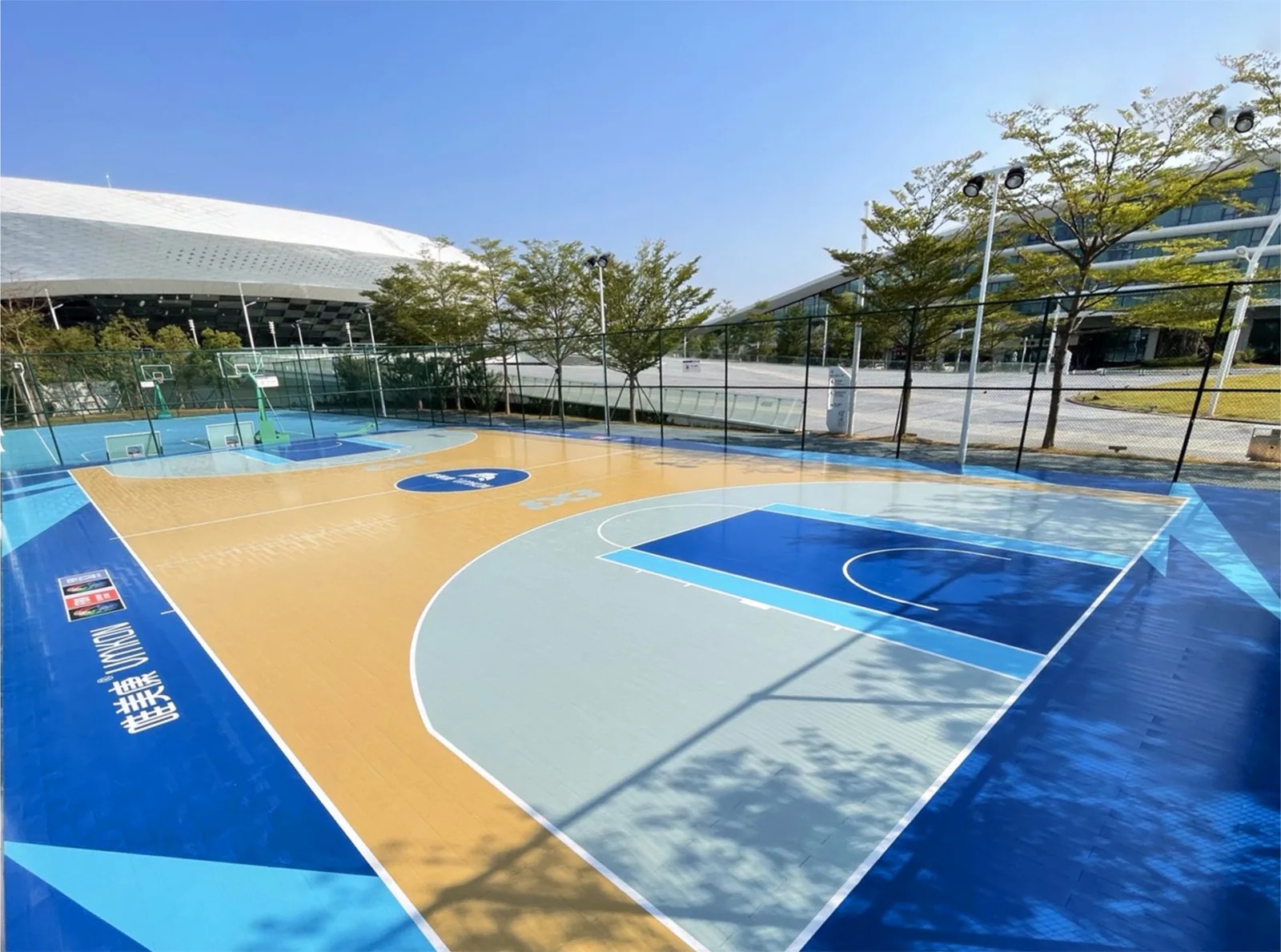
Regardless of whether you are resurfacing or building an outdoor basketball court from scratch, the type of outdoor basketball court material you choose for your final layer will affect the playability, maintenance requirements, and overall TCO of your court.
Traditional Acrylic on Asphalt or Concrete
Acrylic coating systems over an asphalt or concrete base continue to be the most popular for public outdoor courts. They are cheaper at the outset, offer sufficient grip, and can be marked up as traditional basketball courts. The drawback: They need to be cracked, repaired, and recoated every 5-8 years, and they transfer more impact force to a player’s joints than newer alternatives.
Bio-Based Modular Court Systems
The evolution in outdoor basketball court floor material comes from bio-based engineered panels and TPE modular tile systems. These systems install over an existing stable base, which means a court with a sound structural foundation can skip full demolition and transition to a higher-performing surface.
CopoSports is an American-based supplier with a Temple City, California, headquarters that makes bamboo-polymer composite (BPC) sports flooring panels and TPE modular tile systems for outdoor basketball courts, which are made from bio-based materials. Their product line includes:
- Fixed BPC Sports Flooring System (BD-18F): An 18 × 152 × 1500mm bio-based panel on a double-keel structure with a built-in 5mm foam pad. Engineered for permanent outdoor 3×3 and 5v5 courts, it installs over concrete, asphalt, or a stable renovation base.
- Portable BPC Sports Flooring System (BS-25P): A 28 × 125 × 1160mm panel on a removable keel structure for temporary courts, event facilities, and fast project conversion without permanent base modification.
- PowerMatch 16mm TPE Modular Tiles: 250 × 250mm interlocking tiles with a patented expansion joint design that accommodates thermal movement. Soft foot feel, strong shock absorption, and simple tile-by-tile replacement characterize this system.
- PowerPro 19mm TPE Modular Tiles: A thicker-profile tile for courts that require stronger impact resistance and enhanced player protection, with color stability engineered for UV-exposed outdoor use.
CopoSports panels are made of a bio-based composition with input materials from renewable plants, thereby decreasing the need for petroleum-based manufacturing processes as opposed to conventional polymer sports surfaces. This distinction is important if the facility indicates that sustainable material sourcing is a requirement.
CopoSports also allows for OEM/ODM color customization, so contractors and distributors can request court colors to match institutional branding, municipal design standards, or sponsorship requirements.
Why Modular Over Acrylic for Renovation Projects
If a court base is stable, flat, load-bearing, and properly drained, there are renovation benefits with a modular tile or BPC panel system that poured acrylic can’t match:
- No adhesive or coating cure time: Installation takes only days, not a week or more, as with acrylic systems.
- Repairability to the tile level: A damaged or cracked area can be replaced with a single tile, instead of a resurfacing pass.
- Shock absorption by design: The panel structure and TPE underpad absorb impact before it reaches the concrete or asphalt base, reducing joint stress on players.
- Reversibility: Modular and portable plants can be moved when the facility moves or repurposes the space.
The Decision Framework: One Final Check
Before you commit to either path, run your court through this four-question decision tree:
1. Do any cracks show offset edges? Yes → Rebuild. The base moves. No → Continue.
2. Does water stand on the surface 60 minutes after rain? Yes and traces to base subsidence → Rebuild. Yes and traces to surface pitch loss only → Resurface with regrading. No → Continue.
3. Have cracks in the same locations returned after a prior repair? Yes → Rebuild. No → Continue.
4. Does the court age exceed 20 years with no documented maintenance? Yes → Strongly consider rebuild; get a base assessment before committing. No → Resurfacing likely works.
If your court checks out on all four of these tests, then outdoor basketball court resurfacing can offer a solid ROI. If it fails one of these checks, spend the money on rebuilding now, and not on re-rebuilding in two seasons, after surface repair.
Conclusion
Outdoor basketball court surfaces that are cracked and faded do not necessarily require demolition. Systematically inspect and categorise all the faults according to their cause, and act on the condition of the sub-base, rather than the appearance of the surface.
If the base is eligible for renovation, renovate the outdoor basketball court floor material concurrently. Using a bio-based BPC panel system or TPE modular tile system instead of reapplying yet another acrylic layer over the same old substrate extends the court’s lifespan, enhances player safety, and lowers future maintenance costs.
Ready to spec the right surface for your renovation or new build? Visit CopoSports and explore the outdoor basketball court flooring systems available at CopoSports, including a wide variety of fixed BPC, portable BPC, and modular TPE basketball court tile options, or connect directly with the project support team to get a quotation.