Introduction
The appearance of the outdoor basketball court design is directly related with the performance of the players, the length of the life of the court, and also the look of it from the very beginning. Glare, boundary confusion, and fast fading occur due to poor color choices.
Poor markings require players to be constantly repainted and disorient players during quick changes. Every choice, from layout of activity zones to final marking samples, is explained, enabling you to create the court that will last outdoors and stand out in every way.
CopoSports is an American company based in Temple City, CA, that manufactures bio-based outdoor basketball court flooring. All systems come pre-built to meet FIBA line-marking standards and are OEM color-customizable. Refer to the CopoSports outdoor basketball court flooring page in conjunction with this guide to correlate your design with the appropriate outdoor basketball court flooring system.
Why Outdoor Basketball Court Design Differs from Indoor Design
Outdoor courts are exposed to the sun, temperature changes, rain, and foot traffic, which indoor courts never face. Different design logic is required for these conditions.
Hardwood and stain marking systems are used in indoor courts. Outdoor courts use acrylic coatings, BPC (Bio-based Polymer Composite) panels, and modular TPE tiles, each having a different color retention rating when exposed to sunlight. From the beginning, select colours and marking systems specifically for outdoor use, rather than for indoor use.
Some of the design criteria for outdoor use are:
- UV-resistant color coatings that resist fading for a minimum of three to five years.
- Non-glare surface finishes that reduce eye strain under direct sun.
- Drainage-compatible marking layouts that do not block water runoff paths.
- High-contrast line colors (typically white) that remain visible after surface weathering.
Make decisions about these needs before you choose a color scheme or a marking stencil.
Step 1: Define Activity Zones and Buffer Areas
Every outdoor basketball court design starts with zone mapping. Zones determine where colors change, where markings concentrate, and where players need the clearest visual cues.
Primary Playing Zone
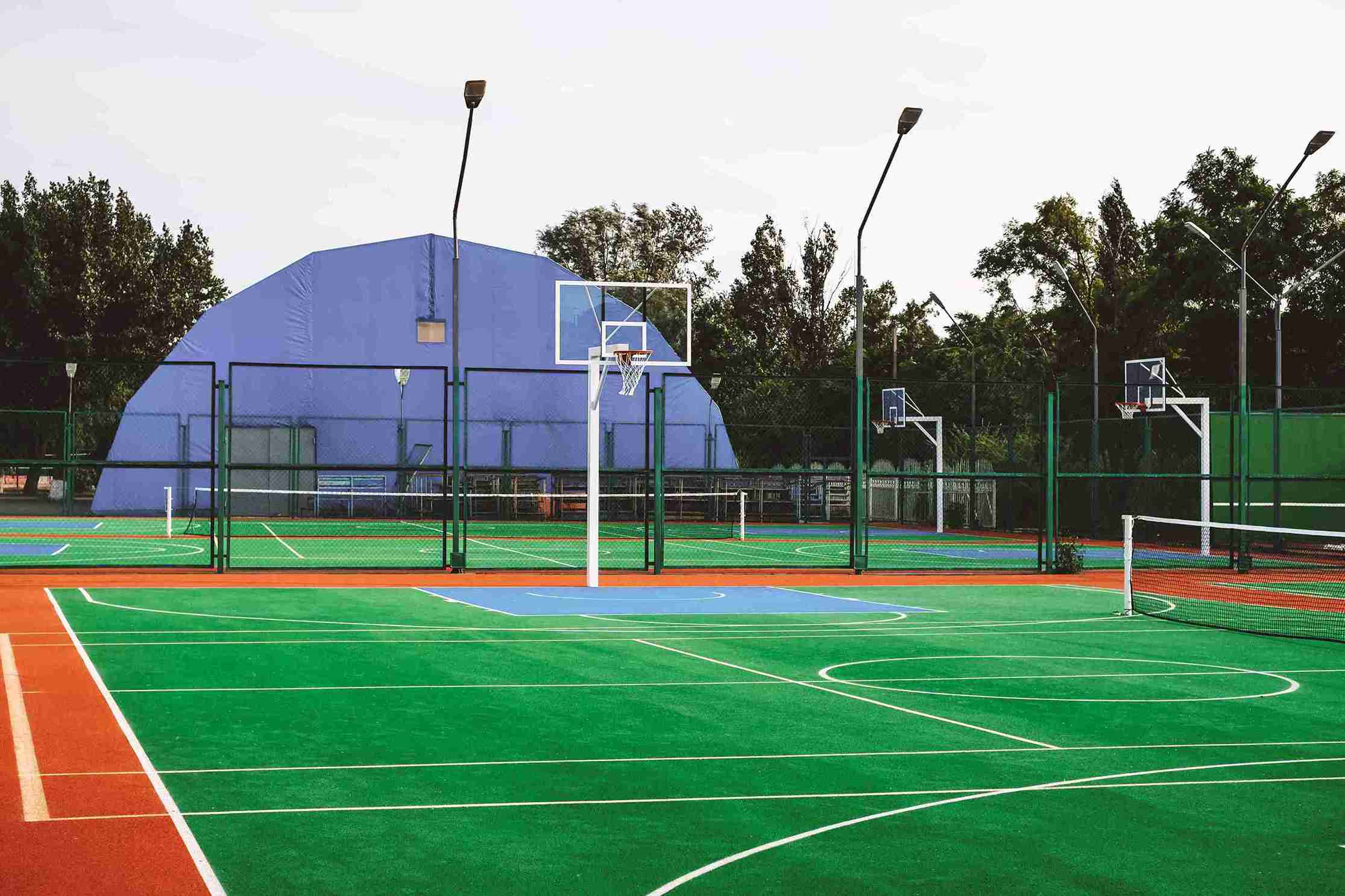
The main playing area is the area of the regulation court surface. For a full FIBA 5v5 court, that equals 28 × 15 meters (91.9 × 49.2 ft). For a 3×3 court, the zone shrinks to 15 × 11 meters (49.2 × 36.1 ft). This area is the color you use on your main basketball court surface, which is usually a solid color, such as a base blue, green, or gray that is UV-stable.
Use the same main color throughout the whole primary area. Do not use multi-coloured main zone base designs. They cause confusion when playing them and make it more difficult to read marking lines.
Key Lane (Paint Area)
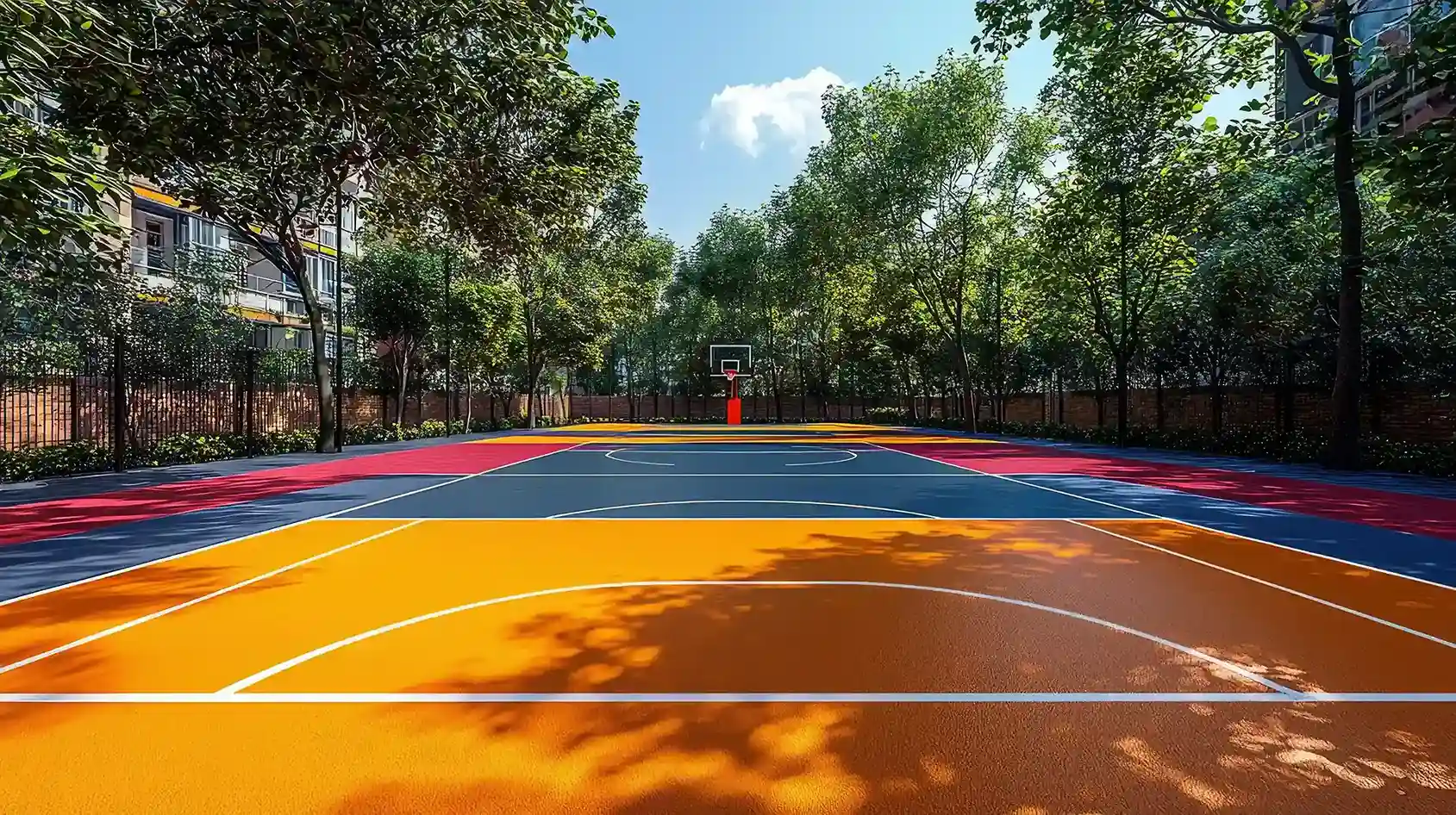
The key lane is the rectangular area between the baseline and the free-throw line, which is painted in a different color to indicate the difference between the key lane and the rest of the court. Popular contrasting combinations are:
- Blue base court + darker navy or red key lane
- Gray base court + teal or blue key lane
- Green base court + dark green or black key lane
The difference between the key lane and main court surface must be significant enough for players to instantly see boundaries at game speed.
Three-Point Arc Zone
There should not be a second fill color in the 3-point arc area. Only use white or yellow line marking. Fill colour in the arc area of outdoor courts provides a more complex fading area and makes it more difficult to uniformly repaint the court over time.
Buffer and Safety Zones
FIBA requires the minimum distance from the edge of a full court to be 2m. This is often expanded to 3 meters for many outdoor projects. These buffer zones are for three reasons:
- Player safety on out-of-bounds runs
- Visual frame that separates the court from surrounding landscape
- Space for drainage slope management
Use a neutral that is different from the tone of the primary court surface (usually a lighter or darker tone of the same colour, or a plain grey) to colour the buffer zone. Do not make the buffer zone color the same as the key lane color, as it generates visual overlap in corners.
Step 2: Assess Sunlight and Visual Conditions
Colors in outdoor courts are different in the morning, the afternoon, and the evening. They change in color from summer to winter. Test the color palette in actual site conditions (overcast vs. direct sun) before making any decision.
Understand Court Orientation
An east-west court favors one team to the morning sun and the other to the afternoon sun. North/South orientation helps to spread the sun glare evenly between the two halves during the day. If it is not possible to control the direction of the court due to site conditions, the effects of glare can be minimised by the use of colour and surface finishes.
Matte or low-sheen surface finishes reflect light, but not in one direction. High-gloss finishes increase glare and decrease the ability to mark them in direct sun. When choosing a finish for an outdoor basketball court surface, any time it is mentioned, make sure it is a matte or medium-sheen finish.
Match Color to Sky and Surroundings
Colors that are UV-resistant and light-reflective, such as pastel green, light blue, and navy with white markings, are most suitable for outdoor courts. These colors minimize heat absorption on the surface and allow the basketball court to be visible all day.
The dark colors (charcoal, black, and deep burgundy) should not be used as the main base color for outdoor courts in hot climates. Dark surfaces absorb more heat, increase surface temperatures, and promote coating degradation. Limit the use of these colors to accent areas such as key lanes or border strips.
Choose a base color that blends in with the environment:
- Courts surrounded by trees: green or teal base colors blend without competing
- Courts in urban or concrete-heavy settings: blue or gray creates useful visual contrast
- Courts in community parks: bright primary colors improve visibility and attract use
Consider the Basketball Itself
Some outdoor basketball courts use yellow lines, which are not as noticeable as the orange basketball, so white is a better line color than yellow. Use white for your first line colour on an outdoor court. White has the most contrast on all standard outdoor court base colors.
When white is the underlying colour of the design (rare, but sometimes found in high-quality residential courts), change the primary line colour to black or navy.
Step 3: Prepare Color and Marking Samples
Do not complete a basketball court design from online images or samples. Make samples and test them in the field prior to ordering full quantities.
How to Build a Color Sample Set
Ask your flooring supplier for sample panels in your 2-3 base colors. CopoSports offers OEM Color Customization for contractors and distributors, and base colors such as navy, forest green, red, slate, teal, and gold, as well as custom colors.
Use a sample of the panels on a small area of the prepared base, preferably in the corner of the actual installation area. Watch the samples at various times of the day. Take photos of them on sunny days and days with cloudy skies.
Confirm the following before approving any color:
- Contrast ratio between base color and white line marking: both must remain distinguishable at all lighting levels.
- Color retention after two to four weeks of outdoor exposure: check for fading or yellowing.
- Surface temperature at peak sun: dark samples run significantly hotter; measure with an infrared thermometer.
- Visual clarity at game speed: walk or jog across the sample area and assess how well the marking lines read.
Prepare Marking Samples
Purchase stencils or masking tape in the correct widths as per your court’s standard. All markings shall be 50mm wide, as determined by FIBA. The NCAA has a slightly different specification. Before cutting stencils, make sure to determine the standard for your project.
Spread the marking sample of the selected line color (white) on top of each base colour candidate. Take photos at various times of the day. The marking sample test shows points that digital mock-ups never catch, such as surface texture and how it affects line edge sharpness.
Confirm Marking Positions Against FIBA or NCAA Standards
As court lines, like the key, three-point line, and free-throw line, are officially mandated, precise measurements are required to ensure the court meets standard requirements.
Standard FIBA outdoor basketball court markings include:
- Center circle: 3.6m diameter
- Three-point arc: 6.75m from the basket center (FIBA), 7.24m (NBA)
- Free-throw line: 5.8m from the baseline
- Key lane: 4.9m wide
- Restricted area arc: 1.25m from the basket center
Chalk in all positions prior to permanent paint. Walk the layout out with a tape and verify all anchor points. Every measurement that relies on an anchor point is changed if the anchor point is moved.
Choosing the Right Basketball Court Surface for Color and Markings
The kind of material your basketball court is made from is extremely important when it comes to color adhesion and marking durability. Color and markings are accepted in various surface systems in different ways.
BPC (Bio-Based Polymer Composite) Panel Systems
CopoSports BPC panels have a bio-based core composition. The BD-18F fixed system is made with 18 × 152 × 1500mm panels with the 5mm foam shock pad built into the system. The BS-25P portable system is a system that mounts on a keel for temporary and event courts.
The factory-applied colour finishes can be applied to the BPC surfaces. This method offers superior long-term UV stability, more uniform colour over the entire court, and no drying time on site, as would be required when applying coatings in the field.
Use a polyurethane formulation line marking paint to mark on BPC systems. Markings after full installation of the panel and before play.
Modular TPE Tile Systems
CopoSports PowerMatch (16mm) and PowerPro (19mm) modular tile systems are composed of rich factory-colored TPE (Thermoplastic Elastomer) material. The patented expansion joint design in these tiles allows them to move with thermal expansion without cracking or separating.
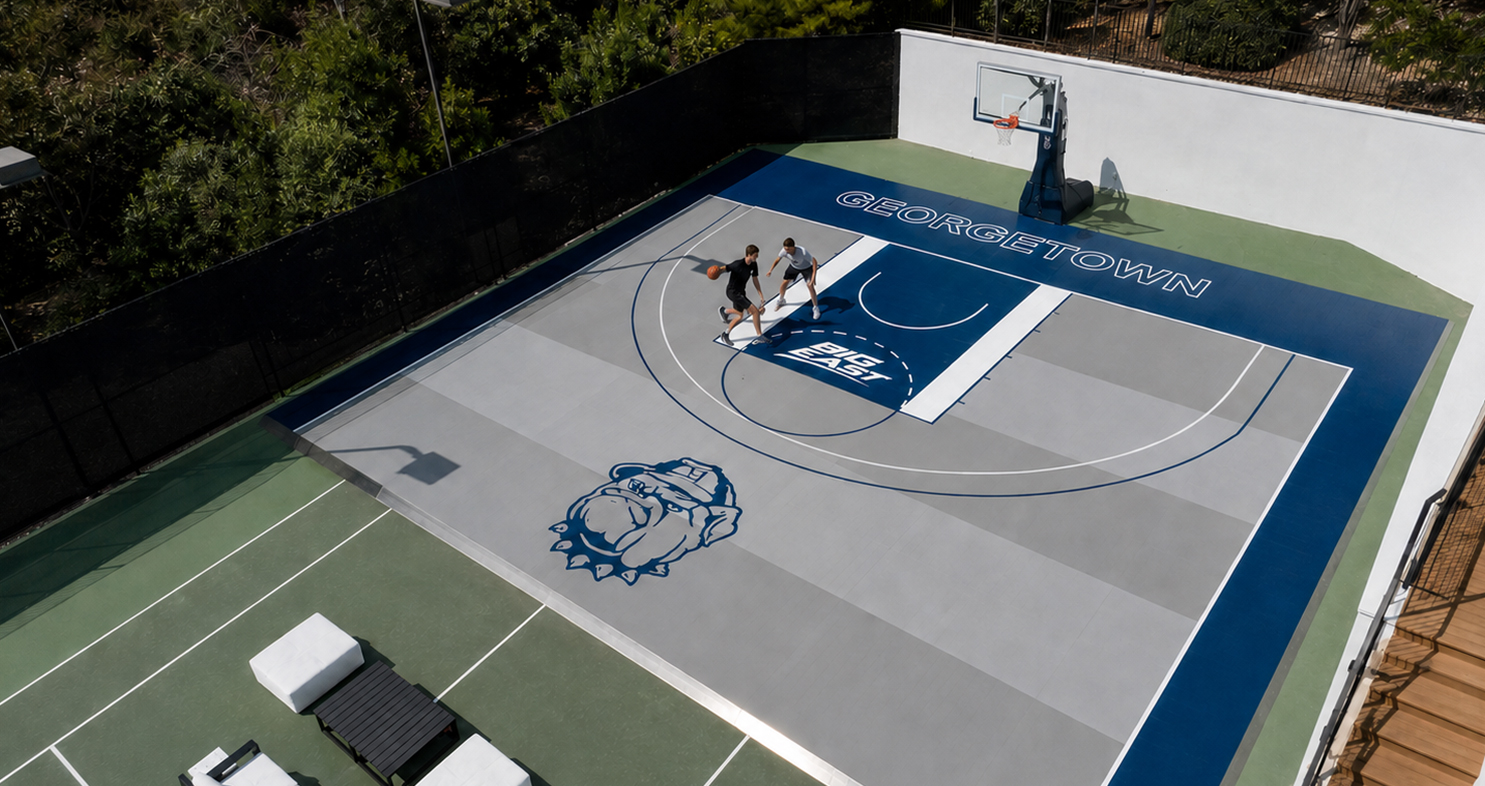
The color of the TPE tiles is in the material, not a surface coating. This means that colour will not fade or peel like a painted surface. Usually, the markings on modular courts are part of the outdoor solution and are built in contrasting colors as tiles so that there is no need for repainting at all.
Typically, the markings placed on basketball court floors are straight lines, which are usually built into the floor tile by the manufacturer and represent the best and most permanent option for outdoor courts.
Common Outdoor Basketball Court Design Mistakes to Avoid
Avoiding these mistakes saves time, budget, and rework:
- Matching the buffer zone color to the key lane color: This removes the visual cue that tells players where the court boundary starts.
- Using dark base colors in hot climates: Surface temperatures can reach 60°C+ on black or charcoal surfaces in summer, reducing player comfort and accelerating coating wear.
- Skipping on-site color testing: Screen colors never match physical surface colors. Always test samples on-site.
- Applying standard indoor line paint outdoors: Indoor marking paints lack UV stabilizers and weatherproofing agents. Use products rated for outdoor conditions.
- Ignoring drainage slope in marking layout: Markings applied perpendicular to drainage slope edges peel faster. Plan marking runs parallel to slope direction where possible.
- Specifying yellow line colors: As noted above, yellow reduces contrast against an orange basketball. Use white.
Final Design Checklist
Before submitting your outdoor basketball court design for approval, confirm every item on this list:
- Primary playing zone color selected and tested on-site
- Key lane contrast color confirmed against primary base
- Buffer zone color defined, minimum 2m perimeter
- Court orientation assessed for sun glare impact
- Surface finish specified as matte or low-sheen
- White selected as primary line marking color
- All marking dimensions confirmed against FIBA or NCAA standard
- Physical color samples tested at multiple times of day
- Marking samples applied and photographed on the actual surface
- Drainage slope confirmed compatible with marking layout
- Flooring system selected: BPC fixed, BPC portable, or modular TPE tile
Get Your Outdoor Basketball Court Flooring from CopoSports
CopoSports is a source of outdoor basketball court flooring for project buyers, contractors, and distributors in the United States and abroad. Fixed BPC, portable BPC, and modular TPE tile options are available for 3X3, 5v5, youth, and public court projects for all systems, which ship from Temple City, California.
The CopoSports team offers OEM/ODM colour customisation to suit your brand, school, or facility needs. Give us a call to get a custom color sample, verify court size and system compatibility, and receive a project-specific quote.
View outdoor basketball court flooring systems at CopoSports →
Frequently Asked Questions
What is the best color for an outdoor basketball court?
Blue, green, and gray are the most practical base colors for outdoor basketball courts. These colors reflect heat, maintain high contrast with white line markings, and retain color stability under UV exposure over multiple seasons.
What color should basketball court lines be?
White is the standard line color for outdoor basketball court markings. White delivers the highest contrast against every standard outdoor base color and remains readable as surface colors weather over time.
How wide should basketball court markings be?
FIBA specifies 50mm (5cm) line width for all markings on a standard basketball court. Confirm the applicable standard FIBA, NBA, or NCAA) before cutting stencils or ordering marking tape.
How often do outdoor basketball court markings need repainting?
Applied-paint markings on acrylic or concrete surfaces typically require repainting every two to four years, depending on UV intensity and foot traffic. Modular tile courts with factory-integrated markings do not require periodic repainting.
Can I use modular tiles instead of paint for court markings?
Yes. Modular interlocking tile systems like CopoSports PowerMatch and PowerPro integrate markings as contrasting-color tiles during installation. This approach eliminates repainting and delivers consistent, durable marking lines for the life of the surface.