Indoor Sports Flooring Project for Court Construction
Sports flooring installation delays are a common challenge in court construction and sports facility renovation projects. For general contractors, builders, and project teams, a flooring delay can affect the entire project schedule, including line marking, equipment installation, final inspection, and project handover.
In many cases, the flooring material itself is not the only reason for the delay. The real causes are often related to site conditions, late material confirmation, delivery planning, project communication, and installation preparation.
For contractors managing sports court projects, understanding these risks early can help reduce unnecessary delays and keep the project moving on schedule.
Why Sports Flooring Installation Delays Matter
Sports flooring is usually installed at a later stage of a court construction or facility renovation project. If the site is not ready or the material plan is not clear, the delay may affect other work after installation.
For example, delayed flooring installation can impact court line marking, sports equipment installation, cleaning, inspection, and final handover. This is why flooring should not be treated as a last-minute material order. It should be planned as part of the overall construction schedule.
Below are the common reasons why sports flooring installation gets delayed and what contractors can do to prevent these issues.
1. Site Conditions Are Not Ready
One of the most common causes of installation delay is that the project site is not ready for flooring work.
For indoor courts, the subfloor may still have moisture problems, uneven areas, dust, or unfinished surrounding construction. For outdoor courts, the base layer may not be fully cured, leveled, or cleaned before the flooring team arrives.
Before installation begins, contractors should confirm:
- Whether the base surface is flat and clean
- Whether moisture conditions are acceptable
- Whether drainage conditions are suitable for outdoor courts
- Whether surrounding construction work has been completed
- Whether the working area is clear and accessible
A simple site readiness check can prevent many unnecessary installation delays.
2. Material Specifications Are Confirmed Too Late
Sports flooring projects often require confirmation of material type, color, thickness, surface texture, court size, quantity, and line marking requirements.
If these details are not confirmed early, suppliers may not be able to prepare sports flooring materials on time. Late changes may also affect production, packaging, delivery, and installation planning.
For example, a pickleball court, basketball court, school gym, multi-sport court, or outdoor sports facility may require different flooring structures and project details. If the final specification changes after the project has already started, the delivery schedule may be affected.
Contractors should confirm the flooring specification before placing the final order, especially for projects with strict deadlines.
3. Delivery Schedule Does Not Match the Construction Timeline
Even when sports flooring materials are ready, installation can still be delayed if the delivery schedule does not match the actual site progress.
Some contractors order materials too early, but the site is not ready for storage. Others order too late, and the materials arrive after the planned installation window.
A better approach is to coordinate the material delivery schedule with the project timeline. The flooring supplier should understand the expected installation date, site access conditions, unloading requirements, storage space, and any special delivery restrictions.
For project teams, delivery planning is not only about shipping materials. It is also about making sure the materials arrive at the right time and in the right condition for installation.
4. Court Dimensions or Layout Are Changed
Court dimensions and line marking requirements should be confirmed before materials are ordered.
Small changes in court size, layout, or line marking can affect material quantity, installation planning, and project coordination. This is especially important for multi-sport courts, school gyms, pickleball facilities, and renovation projects where existing site conditions may not match the original drawings.
Before installation, contractors should confirm:
- Final court dimensions
- Sport type and court layout
- Line marking requirements
- Material quantity
- Installation direction
- Edge and transition details
Clear layout confirmation helps reduce mistakes before installation begins.
5. Communication Between Project Teams Is Unclear
Sports flooring installation usually involves several parties, including the general contractor, flooring supplier, installer, facility owner, and sometimes design or operations teams.
If these parties do not share updated information, small issues can quickly become project delays. For example, a change in court layout, project schedule, storage location, or site access may affect installation planning.
To avoid this, project teams should keep clear communication on:
- Final court dimensions
- Material arrival date
- Site readiness status
- Installation sequence
- Line marking requirements
- Final inspection standards
Clear communication is especially important for contractors managing multiple subcontractors on the same site.
6. Installation Support Is Not Planned in Advance
Some sports flooring projects require technical guidance before or during installation. This is especially important when the project involves new materials, special court layouts, or tight construction schedules.
A sports flooring supplier should not only provide materials, but also support the project team with product information, installation guidance, and practical planning advice.
For general contractors, working with a supplier that understands project timelines can help reduce uncertainty before installation starts.
How Contractors Can Prevent Sports Flooring Installation Delays
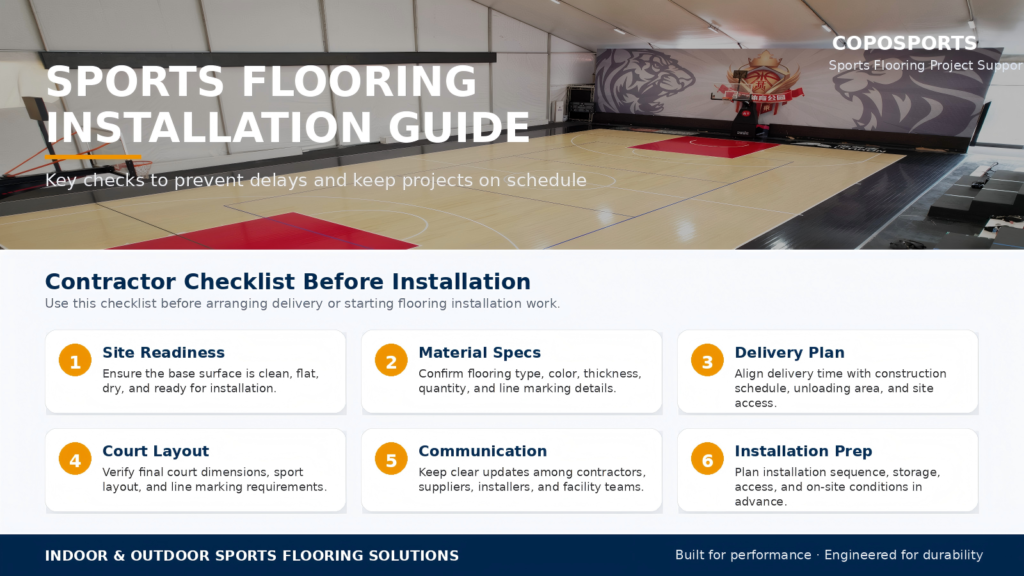
To reduce the risk of sports flooring installation delays, contractors can follow a simple preparation process:
- Confirm the final flooring specification early
- Check site conditions before arranging delivery
- Match material delivery with the construction timeline
- Prepare storage and unloading areas
- Confirm court dimensions and line marking requirements
- Communicate clearly with the flooring supplier and installation team
- Keep a checklist before installation begins
Sports flooring installation delays are usually preventable when the project team prepares early and communicates clearly.
For contractors, builders, and project managers, the key is not only choosing the right flooring material, but also working with a supplier that can support project planning, material coordination, and installation preparation.
COPOSPORTS provides indoor and outdoor sports flooring solutions for court construction and sports facility projects. We support contractors and project teams with material selection, project coordination, and practical installation guidance for different types of sports court projects.
If you are planning a sports flooring project, COPOSPORTS can help you review material options, project requirements, and installation preparation before the project starts.